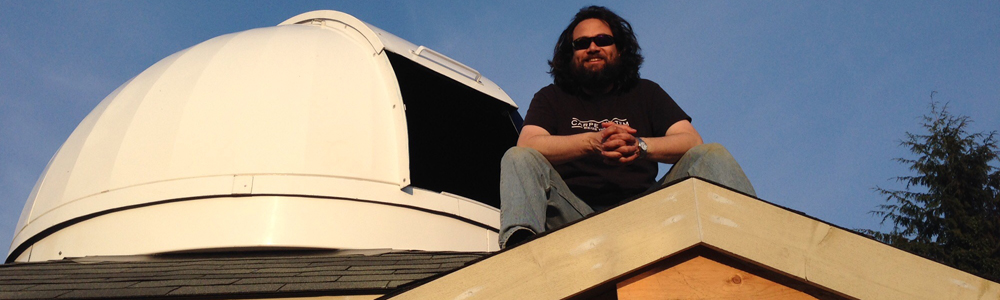

I’m in the process of changing houses.
Among all the other concerns, this means that Ad Astra Observatory at Newark, CA is nearing the end of its run. I’ve had a lot of good times in that little outbuilding, and I wanted sincerely to believe that a “tester shot” of the moon was not going to be the last photons captured here.
But it’s been raining for a couple of weeks now, that real intense kind of “it’s never going to stop” kind of rain, and I was starting to get nervous.
So when the astronomy gods finally cut me a break, I jumped on the chance to get some sky.
Trixie was still mounted up, and I tried her out on some DSOs, but found a small weakness in the mounting bracket which is preventing the guider from getting anything solid. Back the the drawing board, there. So what else is new?
Anyway, I decided to pull Trixie and put up Veronica.
That went pretty quickly, all told, and I was able to get Veronica loaded, balanced, and focused before the clouds started rolling in. This is essentially my first DSO work since the GSSP last July, and as usual, the image shows a little rustiness.
An hour of 10min exposures was all I could get before the clouds took over. It was good to get some photons, but I’m really not all that impressed with the shot.
It was then clear the next night as well, so back out I went, and back into Ursa Major. I decided that if I was going to pull down a junky image, it might as well be a junky image of a new object, so I could impress myself later with “how much more skilled I am now”. So I chased M97, The Owl Nebula. This is an object that I would normally have avoided with Veronica, being a little too small to really show a lot of detail. Also, with The Dipper placed right over the house, I’m sure I was getting some heat bloom off the roof. shrug. The image turned out, eh, ok, just like I expected.
It’s clear again today, so I expect I’ll be able to go hunting again tonight. Maybe I’ll see if I can get the focus tighter. Or maybe chomp some Leo instead of Ursa Major. We’ll see.
Thanks again, Ad Astra Observatory. It’s been a good run.
Veronica is now a Dob/Equatorial Newtonian!
I have been wanting to do this for years. I am forever sitting around on a nice night, camera cranking away on the mount shooting something, and wanting to spend a little time poking around at visual astronomy.
But, since I have pared everything down to just a photography rig, I only have one mount, so while the camera is using the mount, all I have are a pair of binoculars and a pair of Mark II eyeballs.
I had this idea in my head a while ago; since Veronica has top and bottom plates anyway, what if I just threw some Dob bearings onto the plates, and used, say, a 10″ Dob base? That would give me a working scope even when the photo mount is in use, and of course, since I’d just bolted the bearings onto the mounting plates, it would be easy to pop them back off and go back to using Veronica as an astrograph.
I had even figured out that maybe I could use Losmandy DA’s to make it really easy to get the bearings on and off.
I bought (or scrounged) a 10″ Orion Dob base several years ago, but never got around to working out the details.
Until today.
With my success last weekend at carving concentric circles with the CNC machine, I knew that I was on to something. Then I ran across the scrap circles that I’d created while trying to make a mirror cell for Betty all those years ago, and I had my answer.
A quick measurement of the altitude bearing seats on the Orion Dob mount (they’re 5″, by the way), a nail to hold down the 8″ plywood circles, and about 10 minutes in CamBam, and I was ready to roll.
I put some blue painter’s tape around the edge of the bearings, so they would slide better over the “furniture slide” material of the bearing seats. Someday I can replace with better material, but it’s working for now.
A little fiddling around with spacers ensued; it turns out that about 5 flat washers is the required spacing. I have all 5 on the same side of the scope, to make my life easier, but it would work just as well with 2 on one side and 3 on the other.
I spent a little more time fiddling with the balance point, but because of the DA’s, it was very easy to make sure that both bearings were in the same spot, once I found the perfect position. It’s very repeatable, and oh, so easy to remove the bearings when I want to put Veronica back on the NJP.
And it fits together very well, if I do say so myself.
I’ve been an astronomer for 7 years now, but this is my very first “definitely visual-only” scope. Welcome, welcome, Veronica-the-Dob. Don’t worry, you’re going to spend even *more* time under the stars now!
Again, Cygnus is not really my first thought when it comes to open clusters (at least, not ones that seem to have no nebulosity surrounding them). But this cluster could rival anything in Auriga. And the pairing the the (obviously much-more-distant) NGC6946 (see other post from today) just really makes it a wonderful target.
This one was a “freebie”; I was aiming for the galaxy. But the planetarium software said there was a big cluster here, so I framed it in. Very nice.
Cygnus is not generally the area of sky you think of when you think “hey, showpiece galaxy”. But here you go. NGC 6946 has been dodging me for years, so I decided to grab it.
When I pointed over there with the planetarium software, it turns out that there was a huge open cluster right nearby, so I framed them both.
3 bright field stars, too — I mean, seriously. What a gorgeous panorama!
Here’s the whole field. I left the scope running around 1am, and let it go all night. By sunrise, I’d captured 20 frames; I tossed the final one because it was a little sunrise-y. So 190m total, 3h 10m.
And here’s a detail of NGC 6946. It’s a really gorgeous face-on spiral, looks a lot like M101 to my eye. Cool!
I will post the cluster separately, so it’s easier to search for.
20m subframes were slightly trailed, so I stuck with 10m. Didn’t lose a single one due to tracking errors. Thanks, 4026!
Normally, I don’t go in much for edge-on galaxies.
I just don’t think that I really get enough pixels to work with for the amount of effort that goes in.
But NGC4565 is huge. So I decided to give it a shot. What with one thing and another, I didn’t get started on the object until it was right at the meridian, so I only got an hour of it before I ran out of time.
But, not too bad.
The caption in the photo is incorrect; this is a one-hour (6x10m = 60m) integration. Oops.
Here’s a close-up (1500×1000 -> 900×600 crop):
This object is worth chasing with Cassie, and also worth a bit more integration time. Also, plate solving. I’ll get to it.
…with zero dropped subframes.
I spent a little time refining the polar alignment last night. I am still getting some drift while running unguided; I calculated it to be about 6′ from the pole now.
The guiding is even smoother now, if one could believe it possible.
I shot 20m subframes all night. I ended up with 5 frames of M51 (OK, but not worth posting). By the time M51 was finished (around 2am), Cygnus was up, and so I went and grabbed 10(!) more frames of Sh2-101.
The 3h 20m image came out pretty nice, but as always it could use some more integration time:
This is one of my standard 1500×1000 -> 900×600 crop-and-size jobs. There was a lot more context in the image, but Veronica is badly out of collimation at the moment, so there were some badly mangled stars; this is as good as I could get.
Things I noted last night:
- the pier topper needs to be rotated about 1/2″ clockwise, because the azimuth adjustment has run out of room to the west.
- Veronica needs to be recollimated. I am going to pull the long bolts and put the stock ones back in. I think I’m done with the RCC/OAG.
- I am not certain if it did anything bad, but I pulled the webcam out of the OAG and put it into the main focuser partway through the night. I would think that it doesn’t matter where in the FOV the star lies, but better safe than sorry.
- I will not be putting the mount on the tripod for tonight’s star party. I think it’s more impressive on the pier.
- One of the GOTOs last night was so accurate that I looked in the finder, couldn’t find the star, started pushing it around with the hand controller, and realized it was sitting behind the crosshairs. (:
- The mount put up more gaudy numbers; 0.4″ RMS for the night. wow.
A good night. And I got an hour more sleep and still hit a Cygnus target!
Buoyed with the success of the NJP with Pumpkin, I decided to start upping the ante. Pumpkin was mounted offset to one side, but I decided that Veronica should be balanced over the Dec axis. I was already a little concerned whether the DA’s would hold Veronica, and I wanted one less thing to worry about regarding balance. So I reworked the DA’s so they’d fit in the center of the mounting plate, and mounted up Veronica.
At the same time, I decided to mount a couple of finder dovetails on the mounting plate, so I would have a place to mount Guido. That was a measured success; it totally worked for guiding (see guide data below), but was not so cool for using Veronica’s finder; something I’ll fix presently.
Here’s the guide data. The mount is so smooth, it’s silly.
I had been having trouble last night with subframe length; skyglow was eating any images longer than 3 minutes. I wanted to test some 10m and 20m subframes, so I decided to add the Ha filter to the mix. This made focusing a challenge, although the 3-day moon did help out some by staying up late enough that I could use it as a focus target.
Getting FocusMax working again was a bit of a pain. It took about 2 hours (or 3?) before I was up and running and ready to start guiding.
The winter nebulae had set by then (it was about 11:30 or so), and the spring ones weren’t due up for hours, so I decided to run the Ha filter on the spring galaxies. M101 was the target of choice; because the polar alignment isn’t exactly perfect, my “bracketing” exposures missed the galaxy (because the GOTO was inaccurate; I need to add “re-synch on nearby star” to my workflow habit). Once I resynched, Temma put M101 on the CCD.
The bracketing exposures showed that 10m exposures were fine, but 20m are a little too long (I’ll work out later whether 15m can be done).
I had earlier figured out that I can go about 2 hours, 10 min. past Meridian before hitting the pier. I set this up in the mount safety limits, but I still need to make sure that’s actually doing something.
Because I was 30 min. before the Meridian, I set it up to run for 2.5 hours (20x10m exposures, allowing for download time), set an alarm clock, and took a nap. At 3:30a (yes, it took awhile to get started), I went out, to find that the telescope had hit the pier. It actually hit the pier during the last exposure before I got up, though, so not too bad.
I crunched the data once I woke up, and here’s what I got. I think that my data processing workflow could use some help; I stacked this using “SD Mask”, for reasons passing understanding, and got some strange diagonal noise added.
But, this is 16x10m images, 2h 40m total, of M101 in Ha through Veronica.
I re-synched the mount on a star rising in the East (Deneb), and slewed to NGC6888 to see how Veronica could do on a “real” Ha object. I set it up to run for 3 hours (18x10m), knowing that I would be up by 6:30a to turn everything off.
I went to bed, had a crazy bad dream about the mount running into the roof and somehow falling into a lake (wow), and woke up to the mount having lost the guide star because of the sunrise. I only lost one image there, too. Not bad again!
I was a little off on the GOTO again; it was 3:30 in the morning, give me a break. I only got 6 useable subframes of NGC6888; I think a cloudbank hit at some point in there.
NGC 6888, The Crescent Nebula in Cygnus, 6x10m, one hour total exposure, Ha
A reminder that the reason these are grayscale is that this is the red channel only, as the Ha filter only lets data into the red channel.
So, my impressions?
First, the NJP is absolutely destroying my circadian rhythm. I am so tired I could sleep standing up right now.
Second, the mount is so stupidly accurate that I don’t know what to do with myself. The first time I tried to cut the guiding data this morning, PemPro reported a PE curve of +/- 0.0. When I look at the raw data, other than the big jumps that happen in Dec whenever the shutter trips, all of the data falls between 0.0 and 0.4 pixels. From the previous night’s data, I had an RMS periodic error of about +0.3/-0.2, or a swing of about 0.5″. Tonight’s data looks similar. That’s a 20x improvement over the best performance I ever achieved with the G-11 (+/- 5″, 10″ peak-to-peak). NJP good? I’m sold.
Third, I think the RCC is a lost cause. It makes my telescope hard to collimate, and it doesn’t seem to do as nice of a job flattening the field as the MPCC does (take a look at the corners of the images). Now that I am using clip-in filters, and have a mount that is really guideable, I think that I’m ready to pull the RCC, get Veronica reset back to normal, and use the MPCC from here on out.
Fourth, I don’t know whether the IDAS LPS and Ha filter are not behaving properly together, or whether my optics need cleaning, or dew prevention, or image processing, or what, but these images seem a lot noisier and generally uglier than the Ha stuff I was doing last spring. I’ll get my Ha mojo back, just something to note.
Finally, I can’t wait to see what the mount can do once I’ve aligned it properly! Unguided? Crazy long focal lengths? Oh, I think we’re going to find out. Stay tuned.
I have several birds and several stones and I am thinking about applying the latter to the former in a particular way. Here’s what I’m talking about.
Veronica is an 8″ f/5 scope, with the mirror mounted in the original Orion mirror cell.
Betty is an 8″ f/6 mirror that I ground myself, and I have an 8″ University Optics mirror cell and an 8″ f/6 Orion tube to mount in.
The thing is, the University Optics cell has different mounting points than the Orion cell. In particular, the Orion cell extends past the end of the tube and mounts to it.
Currently, Veronica needs to be mounted far forward in the tube, to accomodate the backfocus for the RCC. This is a very unstable mounting method, and causes lots of problems during collimation. I have considered cutting the tube so that I can mount the mirror cell with shorter bolts.
So this seems like it could work out nicely. Move Veronica to the UOptics cell, drill new holes in the tube for the new cell. Put Betty into the Orion cell which will then easily mount to the f/6 Orion tube. I even have an Orion Dob mount I could use for Betty.
I worry a little that Veronica is becoming the Frankenscope. Every part has been upgraded. That’s the price you pay for progress, I guess.
I spent a long time collimating Veronica the other day, with the new autocollimator I bought. That experience convinced me to buy Bob’s Knobs for Veronica and Cassie.
I knew I would have to recollimate afterwards, but I was ready, at least in the case of Veronica, because I knew she was in collimation before I started, so I knew that I would only have to adjust the secondary to get her back in collimation.
Cassie is a different story, but that’s OK, too. I’m out of the night sky business for awhile, so I have plenty of time to get everything fixed up.
I was worried that collimation would take a lot of time after the install. Starting from a good base, it was really quick. Took maybe 20 minutes from the time I removed the first screw to the time I declared Veronica back in collimation and put her back outside.
Not bad. And the new Knobs really make adjustment easy.
Totally worth it.
I had a bunch of maintenance piling up in the obvservatory, so I decided to do some of it since it’s raining all weekend.
I spent a little time getting the mount more level, and adjusting the elevation on the polar alignment. I still don’t think it’s perfect, but I think I’m closer.
The polar alignment still needs adjustment in azimuth, and a final check in elevation.
I installed the new EEPROM (v1.04; apparently 1.05 is only from Goerlich) and a new battery in the mount. I also hooked up the GPS and got the time and location correct.
I mounted up the new autoguider and tried to take a couple of daytime shots to test it out, but the observatory computer fried, so I spent the time to rebuild the observatory machine from the ground up. That took longer than I expected, but I think it’s up and running now. I was having an awful time trying to get VNC to work properly. It was running really slowly on a fresh install of Win XP SP3. After much gnashing of teeth and tearing of hair, I rebooted all the elements of the LAN (modem, router, etc), tweaked the firewall on the new machine, and installed several Windows and Dell updates. Something in there “clicked”, and now it’s up again and fast as ever.
I took the C9.25 to a local park and set up the artificial star about 75yd away. That was more than enough to get me in focus, and with a few tweaks of the collimation knobs, I saw, for the first time, *perfect* Airy disks! I was collimating at 700x, so gorgeous. The C9.25 is ready for… something. It’s back in its (new) case for now, but ready to rock.
Buoyed by that success, I decided to try to collimate Veronica, too. This was not as successful. I will have to read up on collimation, because the closest I could get to Airy disks was seeing little tiny “crosses” (even on the dimmest light), which merged “vertical” if I went one way out of focus, and “horizontal” if I went the other way. There is a ton of light being thrown off outside of the 4 main diffraction spikes, too. I think I’m closer, but I will be using the C9.25 or Pumpkin to do polar alignment and pointing models for awhile…
A very productive weekend, despite only having 90 minutes of clear sky.


