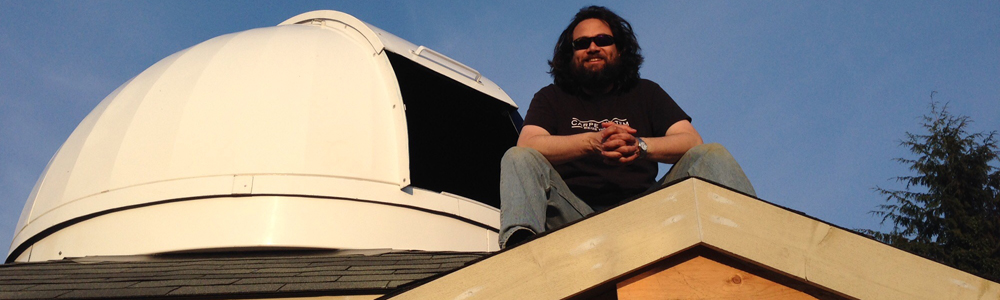

I’m in the process of changing houses.
Among all the other concerns, this means that Ad Astra Observatory at Newark, CA is nearing the end of its run. I’ve had a lot of good times in that little outbuilding, and I wanted sincerely to believe that a “tester shot” of the moon was not going to be the last photons captured here.
But it’s been raining for a couple of weeks now, that real intense kind of “it’s never going to stop” kind of rain, and I was starting to get nervous.
So when the astronomy gods finally cut me a break, I jumped on the chance to get some sky.
Trixie was still mounted up, and I tried her out on some DSOs, but found a small weakness in the mounting bracket which is preventing the guider from getting anything solid. Back the the drawing board, there. So what else is new?
Anyway, I decided to pull Trixie and put up Veronica.
That went pretty quickly, all told, and I was able to get Veronica loaded, balanced, and focused before the clouds started rolling in. This is essentially my first DSO work since the GSSP last July, and as usual, the image shows a little rustiness.
An hour of 10min exposures was all I could get before the clouds took over. It was good to get some photons, but I’m really not all that impressed with the shot.
It was then clear the next night as well, so back out I went, and back into Ursa Major. I decided that if I was going to pull down a junky image, it might as well be a junky image of a new object, so I could impress myself later with “how much more skilled I am now”. So I chased M97, The Owl Nebula. This is an object that I would normally have avoided with Veronica, being a little too small to really show a lot of detail. Also, with The Dipper placed right over the house, I’m sure I was getting some heat bloom off the roof. shrug. The image turned out, eh, ok, just like I expected.
It’s clear again today, so I expect I’ll be able to go hunting again tonight. Maybe I’ll see if I can get the focus tighter. Or maybe chomp some Leo instead of Ursa Major. We’ll see.
Thanks again, Ad Astra Observatory. It’s been a good run.
The second night out with Cassie was only slightly less frustrating than the first.
I don’t know whether there was a slight drop in the seeing or what, but when I really needed the guider to start ripping down those 0.25″ RMS numbers that I know it can do, I was suddenly getting 1.1″ guiding. Which would not have been a problem with Pumpkin on top (which shoots at 4″/px or something equally disgusting), but Cassie shoots at 0.6″/px, so I ended up with trailed or blobby stars. Again.
I got so disgusted that I set up on a straightforward object and just left it running for the night. I was in bed by midnight or so.
Things had cleared out a lot by the final night. The website was not all that clear about which nights were really part of the star party, so a lot of people left after 3 nights. I spent a little time wandering around. Dave B. (who I know from the Chabot Mirror Workshop) was annotating his Uranometria as he was working on searching down the last few NGC galaxies. There really are a lot of different ways to approach this hobby. (:
I started the night during twilight, shooting some widefield of the moon and the “observatory”.
I lined up the mount on Antares as soon as darkness fell, so that I could make another attempt at B27, this time with the mount aligned with the OTA pointing east instead of west.
The seeing was very jittery down near the horizon, and I was not entirely sure of my pointing accuracy. So I only shot one frame of B27. When it came out with badly trailed stars, I moved on.
I think that my polar alignment could have used some refinement. Also, I bumped the mount at least once while trying to move the battery bank around. I had also slammed my head into the telescope earlier in the evening (I am currently sporting a large knot on my head as proof), but I didn’t want to waste a bunch of time on polar alignment, so I just went with it. Turns out that after all that, I was still pretty close. I slewed the scope from near Antares to Sadr to move from B27 to my next target (NGC6888), and was only off by a very small amount in the finder. Nice. Still, ouch. But nice. Very solid mount.
The next target was the Crescent Nebula, NGC 6888. I have fought this object at all focal lengths longer than Pumpkin. I worked this one for an hour, then moved on, intending to do several more objects on this night, as I had on the previous.
I admit I was pretty tired. Four straight nights of staying up late and then sleeping on the ground will take it out of you, no matter how cushy the tent accommodations are. So when the stars came out a little blobby on NGC6888, I decided that my next object was going to be the last one of the star party.
I thought about it for awhile, and settled on another object that’s difficult from my backyard, NGC7293, The Helix Nebula in Aquarius. This is the largest and closest planetary nebula to Earth (if there’s a larger one in the Southern Hemisphere, I apologize). But it never gets very high from my latitude, and with the observatory walls, roof, and That Palm Tree conspiring to make life below 0deg Dec difficult, I just haven’t shot it much.
It had just barely cleared the horizon when I slewed. I knew this would make the seeing sketchy. But I was tired and irritated at the SCT and my head hurt and I was basically done. So I ended up getting 4 hours of this object! w00t!
I also decided to drag out the hubcap and work some all-sky images. I had a very strange hardware failure; the 2.5mm plug for The Gizmo Neue had become detached from the rest of the plug. I thought about it for awhile, but had no spare. So I was limited to either manually holding the remote release button (which I did for a half hour or so), or 30sec images, which is the longest you can do without a cable release. Once my patience ran out on holding the button, I reverted to the 30sec thing. I set up the Mac to take a 30sec image every 3 minutes, and left it running all night. In the morning, the Mac’s batteries had died (first time for that!), so I am not sure how many of these I got. I’ll process them and get the results posted.
I know that it sounds like I had a tough night. Let me say this. The seeing was eh, ok. The heat and wind during the day were something I could have lived without. Overall, the star party was awesome. The skies were dark, dark. And the rig worked really well, pretty much as well as it does when I’m in the backyard.
After two nights of unmitigated success with Pumpkin, I decided to “zoom in” a little (well, a lot, really), and put up Cassie on the third night of the star party.
Mounting up and focusing was pretty straightforward. The cable harness really makes OTA swaps easy. And the Bahtinov worked flawlessly, as always.
Buoyed by my success, and because I wanted to spend some time in the southern Milky Way, which the Temma was hating because it was right near the meridian, I decided against my better judgment to set up with the scope pointing “west” instead of “east”. This should not make a difference. But I have never been able to shoot west. I don’t know why. Maybe it’s a balance thing, maybe a cable pulling problem, I have no idea. But through several mounts, scopes, and guiders, I just can’t get it done. But I try anyway, every once in awhile.
This decision neatly bifurcated the night into a “pointed west” portion and a “pointed east” portion. Let’s just say that the same suckage I am used to when shooting while west was happening. And I picked up some awesome photons anyway, but the stars were just not as tight as I’d have liked.
I started on an easy one, M20 The Trifid Nebula. This is one of my favorites. I think I’ve shot this nebula with every single OTA I’ve owned, with the possible exception of Pumpkin. I have attempts on film, with the D70 (pre- and post-mod), and now with the 350D.
The subframes on M20 were coming out looking gorgeous (albeit with non-perfect stars), so I moved on to M16, The Eagle Nebula. This one was made world-famous by the Hubble Space Telescope’s signature photo of “The Pillars of Creation”. Another gorgeous nebula that I haven’t spent enough time on because of the whole southern horizon situation in the observatory.
I admit that I was a little overconfident at this point. I moved from these known and easy targets to a complete unknown that was further west and about to set, B27 The Snake Nebula, a dark nebula in Scorpius. I only took one subframe, because I was having serious trouble with the guider in all the mucky seeing at the horizon, and the stars are badly trailed. sigh.
So I decided to see if I could get a better result, still pointed west, if I attacked something up near zenith, so I went after NGC 6820, a often-overlooked nebula up near Cygnus. Two subframes of that was all I could take; let’s just say that the guiding was junk up there, too.
So I gave up and switched to east-pointing.
But if you’ve been paying attention, all the Milky Way objects were now starting to slide too far west to do any good, and it was starting to get late, so I had to pick something in the autumn sky that was suitable for the tiny FOV of Cassie. And this is where my lack of experience with the OTA and with that part of the sky started to bite me. I ended up landing on NGC7331, a big (although that’s a relative term) galaxy near Pegasus. NGC 7331 is the largest galaxy in the Deer Lick Galaxy Cluster (named after the Deer Lick Gap in SC). It’s very near Stephan’s Quintet, but not close enough to get them both in Cassie’s relatively tiny FOV. Anyway, I had to slew to NGC7331 manually, because the Temma got mad about zenith again. And… I slightly missed. I got the main galaxy, but the little buddy galaxies are off-frame, I think. Anyway, it was late at this point, so I went to bed, and woke up at 5am to shut down and cover the scope. I got 2 hours of usable subframes on NGC 7331.


