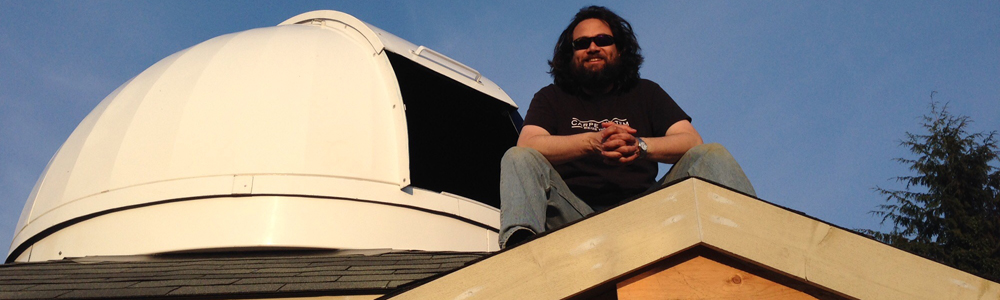

I had a few small tweaks to do, and I was ready to roll with Trixie 2011.
I focused the camera on the moon; this involved no small amount of gymnastics, as the 10 day moon was just past zenith.
I then aligned the finder, and was able to point the scope at M42, where I found that I needed to tweak the collimation.
So I tweaked the collimation, requiring me to realign the finder and refocus the camera.
With that complete, I decided to try to shoot some M42. That went… meh. It was pretty cloudy, and Orion was low enough that I was getting light reflecting off the observatory, not to mention a bright moon nearby (just east of Gemini). Trixie’s debut as a DSO scope will have to wait for a nicer night.
I shot some action photos of the scope and mount (I’ll post those later), and was about to shut down in defeat, but decided that I’d give the moon a try, even through all the clouds. I shot 50 subframes, each 1/1000th sec, at ISO 200 (that’s about as short of an exposure as the DSLR will do in MaxIM). I daresay I had some success.
Click for a larger image.
Nice.
Everything could use a little tightening and tweaking; collimation, finder alignment, motor focuser, balance. But I can officially call Trixie a lunagraph (I have yet to be impressed with her performance on stars
)!
Trixie needed a new mounting plate in order to get installed and balanced on the NJP.
The Triad bar took a little finagling to get in place; I had to build a new mounting bracket for it. The new bracket went together pretty well, and feels sturdy.
I took the scope out to the observatory, unmounted Veronica, and opened the roof so I could start working on Trixie. Man, that is a whole lot of scope. I hope I don’t have to dismount Trixie for awhile.
Balance in RA went pretty easily. Balance in Dec takes a little more effort. I had to rewire the cable harness to allow the cables to reach up to the focuser. In particular, I had to move the camera power adapter into the “Velcro stack” at the saddle. There was a lot of moving things around involved. Once I got all the wires in place, though, I could test the Dec balance. It’s still a little nose-heavy, and I don’t have a finder installed yet, but I was able to add some counterweight to the mirror cell and get it pretty well balanced in Dec.
I didn’t hear anything that sounded like something failing to hold, so the next step is collimation, and then I’m ready to roll, I think!
WIth the NJP back in the observatory, I spent a little time trying to get Trixie mounted up, to test out the rebuild.
I was a little worried about how the mounting plates were going to work on Trixie.
On the other hand, I was also worried that things were going to rip apart, strange cracking noises, and a number of other things.
Yeah, so it turns out that my fears about the mounting plates were well-founded. Because of the way that the plates attach relative to the truss tubes, there is not enough space for the saddle knob. sigh.
I could replace the knobs with machine screws, but I am also thinking that I might just use a different mounting plate. I just bought a Casady Triad Bar, which is designed for mounting 3 scopes side by side, but I don’t really have saddles to use with that anyway, and the Triad is several inches longer than the DC17.25 plates I’m using, so I might be able to figure out a win in fairly short order. It’ll take a little time.
One thing to note: I finally got to use both my 3rd NJP counterweight and the Beer Can extension! Man, Trixie is heavy. I got things “kind of” balanced in RA; it was still very much “over here, it’s CW heavy, over there, it’s scope heavy” with weights in the same position. Yikes. I will have to spend some time scratching my head over all of it.
Oh, and I really need to find an easier way to mount the scope. It is a real back-breaker to get up to eye level. Maybe I can figure out some kind of way to mount it while Trixie is standing on the ground…
I found a couple of cool places where I could prop Trixie against a wall while still on the mount, so I could mess with CW without having to keep a hand on the CW shaft. It is one big scope. Honestly, I’m not going to be able to really automate a photo run with Trixie inside the observatory. I’m going to have to be out there, babysitting a lot, to make sure the scope isn’t grinding into a wall.
Good news, I didn’t hear any strange wood cracking noises. I didn’t get a full chance to test things, but this is good news. And really, I think the new OTA is more than stiff enough.
I have an idea in my head how to fix the mounting plate. It will just take a little time. And a screwdriver.
Don’t worry, Trixie. You’re still looking “go” for photos. Soon. Just please let me get the scope on the mount and then not move it for a few months…
Epiphany is a wonderful thing.
You thrash around for a long time, trying to figure out the solution to a wooly problem, and then all of a sudden, it comes to you.
Trixie’s Dob bearings were jumping off the rails of the rocker.
And I finally hit upon the solution. And it was dead simple.
A few minutes with a miter box, and Trixie suddenly had new sideboards to keep the bearings from sliding off-track. I added the furniture glides as well, and suddenly, Trixie’s altitude motion problem was solved. It was exhilarating.
The altitude motion was so easy that I immediately discovered that, as I suspected, the scope is a little nose-heavy. So I Velcroed a counterweight to the back of the mirror cell, and that solved the problem.
The movement in altitude is just smooth. In fact, it’s smooth enough that the azimuth movement now feels a little jerky. I’ll have to loosen the pivot bolt a little and see if I can fix that.
At this point, the complaints about scope performance turned into quibbles. Yes, I could add felt here to stop some rubbing, the poles could use insulation because they get cold, that kind of stuff. But the scope. just. works.
I spent a little time cruising around with the new rig. I visited a few new sites from the Winter and Spring sections of _Star_Watch_. I visited M36/37/38, M78, M65/M66, M51, and split Beta Monocerotis at 47x. Star hopping is still a bit unnatural to me. I like being able to find things by seeing where lines between major stars cross near the object. Maybe I’ll write my own book.
I did not find M101, M97, M63, M94, M3, or NGC 2903.
The spring galaxies are *dim* compared to the winter nebulae, even when they are high in the sky. It took a *long* time to find M65/66, but once I did, I was able to find M51, which I’d spent a lot of time hunting for, but hadn’t found on the first try.
The light pollution is horrid around my house. Between neighbor’s lights and the unshielded mirror, I really took a beating trying to find fuzzies. I am certain that if I hadn’t moved on to photography, I would have stopped doing astronomy very quickly. Carting off to a dark-sky site on a random Tuesday would not really happen with small kids, and there’s not a lot to see from my backyard, even with a big yard cannon like Trixie. Sure, we’ll see how she does once the shroud gets built, and there’s a lot to be said for dark adaptation and, frankly, becoming a better observer. But I continue to be convinced that photography is the way to go as a suburban astronomer.
I’m looking forward to getting the NJP back to see how Trixie performs under duress. But I’ll keep using the Dob mount until it does. There’s cool stuff up there.
And it’s very nice to have a scope that just… works. Very cool.
As with any other Beta test, taking Trixie out under the stars revealed a few things that still need a little tweaking.
In particular, the altitude movement is garbage.
So, I spent a little time troubleshooting today. I carefully measured the rocker box and the bearings, and I found:
- the rocker box is about 1/8″ out of square. I am letting it go. That should be insignificant across 3/4″ plywood.
- The focuser-side bearing is non-vertical,
- The bearings are not angled the same amount (one bearing is rotated “clockwise” relative to the other)
- the bearings are “toe-out” (closer at the back than at the front), and
- the bearings, when parallel (I know, I’m skipping ahead, work with me), are 1/2″ wider than the rocker.
First things first.
If the bearings are off in rotation, no other measurements are really valid, so I fixed that first. The ring-side bearing looked like it was the worse offender as far as being attached incorrectly, so I moved that one.
Once I’d fixed that, I noticed that the ring-side bearing was touching a truss pole, so I filed away some wood from the bearing until it doesn’t touch the truss anymore, and voila! all of a sudden the bearings are parallel to each other, and the focuser-side bearing is vertical! w00t!
This was when I noticed the 1/2″ discrepancy (see, skipping ahead). Turns out I just simply cut the rocker box the wrong dimension. So, I had several choices on how to fix it:
1) move the rocker sides out by 1/4″ each. This would exacerbate already-bad balance problems between the rocker and ground board, and would look funny, and would be weaker than the current build. No thanks.
2) buy more wood and cut out a new rocker bottom. While this would work, it is really a gnarly and “done”-killing method. I may do this later, but not yet.
3) trim the bearing spacers. I can’t trim the non-focuser-side bearing spacer at all, as it’s barely doing the job of keeping the scope from scraping the side of the rocker. Trimming the focuser-side bearing spacer is doable, but I would have to do more modification of the bearing (as in, cut a huge chunk out of it). This was the second best idea.
4) add another layer of ply to the outside of the focuser side of the rocker box. That would give the focuser-side bearing somewhere to ride, and neatly solve the problem. Not to mention I already had chunks of wood with more or less the right arc cut into them sitting around. This is the method I chose. I looks ghetto as hell, but it works. At least enough to move on.
A little sawing, a little sanding, and now both bearings are riding in a section of wood more than large enough to handle them. Sweet!
I didn’t get a lot of chance to test tonight; I had other stuff going on. But it feels like the Dob base is nearly complete.
I still have to put in the furniture slides on the altitude axis, and I am still thinking that I will probably put in “bearing keepers”, little chunks of wood that keep the scope from sliding left and right out of the altitude bearing seats in the rocker box. I have dozens of little chunks of wood lying around waiting for just such an occasion.
And I think, barring any unforeseen, that will be that. Once I get the whole scope up and running, it’s time to take everything apart and varnish.
Well, maybe I’ll wait for warmer weather…
Well, nobody can say I didn’t pay my dues on this one. Between weeks of rain and countless trips to the hardware store, I think I earned myself a little starlight.
After causing the first snowstorm in San Francisco since 1976 (hey, I was here for that one, too… hmm…), I finished up the Dobsonian mount today, just in time for the only clear night we’re going to have for awhile. Nice!
I was shoring up the rocker box right up until dinnertime, and took everything outside after dinner to find gorgeous clear sky from horizon to horizon.
First, an observing report. Then, a report card on the scope and mount. Before I get started, here’s a pretty goofy photo of scope and builder, best I could do outside in the dark.
On with the show.
Well, I finally completed the Dobsonian mount for Trixie. The idea is that I wanted to have a backup scope for use while the NJP is in use doing photography.
I learned a lot from doing the build, and there are still a few things that need finishing up, but I’m pleased with how the mount turned out.
Here’s a look from the front of the scope:
Now for some clear sky!
I know that there is going to be a moment in the not-too-distant future where my pile of Dob base parts will suddenly take shape. I feel like I’m almost there, but there is definitely some work left to be done.
OK, part by part breakdown:
Altitude bearings:
- bearing surfaces need to be sanded flat
- Edging material needs to be attached
- Mounting holes need to be drilled
- spacers between bearing and DA need to be figured out (and do I have enough width on the base to support spacers?) I decided that it’s OK to have one pole clamp that requires a screwdriver in Dob mode. That should make the spacers work on both sides of the OTA so that the DAs will each have space between them and the bearing. I still need to check it against the actual rocker box, but I am confident that I did the math (and the cuts) right. I measured the OTA against the rocker box, and I need 2-1/2″ of spacer on one side, and 1″ of spacer on the other. I think that I can get these widths by ripping a 2×4. If so, then I can cut 2 lengths of 2×4 (>2.5″ long), rip them, and attach to DAs using 1-1/4″ (or 2-1/2″, as appropriate) screws. Then I can attach the bearings using more 1-1/4″ screws (ditto on the longer ones).
- I may need to make cutouts in the bearings for the poles to go past (can I make them strong enough with the cutouts taken out?) I don’t think I’ll need a cutout with a 1″ spacer, but I still have to figure that part out.
Rocker sides:
- slider things need to be installed (must be done after the bearings are mounted)
- mounting holes need to be drilled in lower edge
Rocker bottom: DONE 2/25 5pm
- mounting holes need to be drilled in side edges
- slider stuff needs to be trimmed to length
Ground Board:
- still needs to be cut and drilled (but I have a working CNC pattern for it)
- sliders need to be installed
- feet need to be designed and attached – I have enough hardwood 1×2 (really 3/4″ x 1-1/2″) to make 3 (1-1/2″ square) feet for the ground board. I also have enough furniture sliders to make covers for the wooden feet.
- pivot bolt needs to be installed and checked for balance, etc.
Front and back end boards:
- need to be sized (I think these need to be 25.5″ long) and cut out of remaining plywood
- how tall does the front one need to be?
I don’t know if the balance point is calculated to any accuracy at the moment; I need to check it. There will be sort of a minimum height required, or else the mirror box will scrape the rocker.
OK, work the todo list, and I’m almost there. A few focused hours when the kids are awake and I can do most of the “noisy” stuff.
I’ve moved into the CNC part of the program on the Dob base.
I started with an easy one. The rocker bottom just needed a countersunk hole for the pivot bolt. It needed to be dead center. The countersink needed to be the correct size to hold a 7/8″ washer, which will end up being sort of a metal-on-metal bearing. I measured the center of the part out by hand, and ran the shortest CNC program ever.
The washer fits very snugly, and looks really cool.
Then I tried to do the ground board, but ran into a complication: the height of the piece is 20.6″, but my CNC machine will only do 19.5″. So I tried adjusting the part a little to make it fit, and decided to table it for the moment, and move on to the altitude bearings.
The bearings provided their own complication; the bearings are 23.5″ wide, so I needed to figure out how to carefully set up the workpiece to fit both parts. This led to an interesting “discovery”, that the CNC can easily run off of one end of the table, but can only come within maybe 12″ of the other end. This obviated part of the cut, but it still took some setup.
I was most of the way through cutting the first bearing when disaster struck. An aside, I like the word ‘disaster’, ever since I learned that it means “bad star”. Makes a great astronomy adjective. Anyway, back to the show.
The router jumped into the bearing, and the router and computer both shut down. The power strip that I’m using has an irritatingly easy-to-trip breaker in it. When I looked at the position of the end mill, I realized what had happened. OK, another aside about the way my CNC machine works. I have to tell it to go to a particular depth, and that depth is based on a “zero point” that I set by touching the mill to the work surface. Also, 3/4″ plywood is only “nominally” 3/4″; it’s actually a bit short of that. Often, the plywood isn’t all that flat, either. So to make sure you go through all the layers of the ply, you often end up gouging the CNC table a bit on the final pass…
And this time, I hit one of the mounting bolts that’s holding the CNC table together. It chewed up quite a bit of the bolt head, and crunched the end mill a bit, too.
I reset everything as well as I could, but that bearing is going to take a little more sanding than I normally have to. oh well.
The second bearing went very smoothly.
Here’s the finished pair.
The end mill is pretty trashed now. I need to get it sharpened (and I’ve got a new one on order). I am almost done; I just need to cut out the ground board, and I can start constructing.
I am actually of two minds about the ground board at this point. I could use the current (and nearly trashed) end mill, I could go buy a 1/4″ router bit at a local store, I could use the 3D bit to complete the job (although it would look a little weird), or…
I could just decide to leave the ground board rectangular. There’s something to be said for simplicity.
That’s a decision for tomorrow. I’m tired now.
Good work today. Nearly there!
I did a little bit of cleanup on the parts (I cut the rocker sides down and chopped the bearings in half, and did some sanding).
Most of the rest of the evening was spent figuring out how to lay out the parts that will be cut by the CNC.
The parts that need CNC work are:
- The rocker bottom — just needs a hole for the pivot bolt (with countersunk head/washer)
- The ground board — Needs to be cut into a triangle and have the pivot bolt hole cut
- The altitude bearings — I am considering the concept of buying a new piece of ply, then cutting out the bearings that way (I’m not happy with the manual methods I used), so I wanted to lay out the part as well as the cutouts, making sure that the cutouts left meat for the DA to attach to.
I finished all 3 CAD drawings. The ground board was the toughest by far; it took several iterations to figure out how to ease the corners of the triangle, and I’m still not 100% sure how it will cut. But I have high hopes.
The altitude bearings were kind of fun to do, if a little tedious. It was a lot of rotation and translation and “cut at intersections” work, and I am looking forward to seeing them get cut out by the machine.
Now that I think about it, all the cuts are pretty simple, but they are also quite large pieces, and I can see the CNC machine being busy for several evenings doing all the work. It’s enough to make a person want to cut out more than one scope at a time…
Anyway, the sky was taunting me tonight, clear as a bell. grumble.
I have to cut the ground board one way or the other, and the rocker isn’t going to center-bolt itself, so I can’t really avoid all the CNC work, but I can prioritize the cuts and probably get up and running either tomorrow night or the night after, depending on how fast the machine can cut out the parts.
Once all the parts are cut out, I need to start construction. Another plug for a new piece of plywood: I need to cut out the rocker front and back at some point, and a new piece of ply would leave me a lot of leftovers for that. I also have to remember to buy or build myself some feet, both for the ground board, and for the OTA.
Good progress tonight.


