It’s been clear and cold here for the past 3 nights.
I went out two nights ago, and found out that I can see Alpha Columbae down near the horizon. A Col is around Dec -35º. Sure, it would go behind trees a lot, but I’d have a little time to get after it.
M8 is around Dec -25º, so that should pose no problem. I just have to make sure that the scope is situated in the dome to allow viewing down to no less than 15º above the horizon (Dec -47º from here, so call it Dec -32º or so). This actually helps out with observatory design a little, as a requirement of being able to see the horizon means the scope has to stay above the dome wall, but being able to protect the scope a little means a slightly lower pier… Needs to be figured in.
My wife has also suggested that she might take out a couple trees that would otherwise have been blocking my southern sky. Interesting. I’ll see how that figures in, too.
One way or another, between the house (which will block everything up to about 45º elevation in the west) and a very irritating patch of trees in the east (the New Nemesis Palm Tree… grr), I’ll need to model the horizon carefully, to see where the best placement of the observatory will be.
I sketched out what the building must look like if I want to do a lower “warm room” and an upper “scope room”, both with ceilings that are high enough for me to walk around in; I’m sure it comes as no surprise to anyone who’s ever done construction to hear that the two-story solution will result in a building that’s at least 18′ tall. I need to do more drawings.
I got some great news today! Turns out that I have a concrete contractor in the family. He’s offered to help me out with pouring the cement required for the observatory! Awesome! I haven’t really gotten to the part about what the cement will look like; obviously, I need at least a pier. The pier might need a “deadman” at the bottom, especially if it starts getting 10′ or 12′ high to make it into the “upper story”. But I’m not far enough along in design to know whether I want to do a simple deck or some kind of structure, or a foundation… honestly, I think I want to talk with him about the design aspect some, and let him help me figure some of it out. I am grateful to even be considered.
At the moment, I’ve pretty much decided on a dome. And that choice comes down to either a 10′ HomeDome, or a 12.5′ SkyShed POD MAX. The main sticking point right now is whether I buy the dome a la carte, and put a building under it myself, or whether I buy the dome “with walls” and learn to live with whatever compromises that entails regarding getting it just the way I want it. It’s certainly cheaper to build it myself (one assumes that for the approximately $2k – $4k extra that I’m going to be charged for the observatory building by the manufacturer, I could build a pretty extensive shed out of lumber and ply), but it’s more of a turnkey solution to just buy the thing and get running.
My main concern is that both HD10 and MAX have usability problems with the “wall” pieces. The HD10 is very flexible; you buy wall sections 1′ at a time, so you can make the thing any height you want. But essentially, my understanding is that the assumed “dome entry” is to open the dome slit and vault the wall. Also, the 1′ sections look pretty dumb. The MAX goes for more of a “they tried to guess what I’d want” solution, and end up with 6’4″ walls (meaning the scope has to be mounted pretty high up to peer over that, but otherwise nice), but with only a 5’6″ door (sorry, but that’s simply too short. I’m 6’2″, and I banged my head on the observatory door in CA more times than I can count). So either dome is going to need some modification to get the entry and height right, and once I’m going down that road, wouldn’t it be easier to just build the thing myself? I’m torn.
A simple solution might be to have the observatory up on a slightly elevated deck, so that you swing the door open, and there’s a little “trapdoor” in the floor of the observatory at knee level (for instance) that you swing up to reveal 2 or 3 stairs up into the shed. Then you get the shorter door, the benefit of a little more height, and all you have to do is climb a couple stairs. Flop the trapdoor down, and you wouldn’t even know it was there. Might be nice to have a crawlspace under the observatory, for easier access to..? who knows. Anyway, I’m still thinking about it.
If I put up an elevated deck, maybe I could build a foundation instead. I’ve been thinking about building something in brick or stone — makes it feel like I’m doing something permanent.
More drawings.
OK, so I measured the yard, and it doesn’t look like I’m going to be able to get the “peekaboo” view between the house and the shop, at least not for a permanent setup. It’s just too close to the street.
By the same token, I don’t really want a north-roll-off roof, because of the same problem. However, since I’m going to be stuck in a place where the house is blocking Seattle’s light pollution anyway, I might be able to swing a west-roll-off roof, and have most of the south wall roll away, too. It’s a thought.
My ruminations have come down to essentially 3 options:
- west-roll-off roof, 12×16, single story
- 10′ HomeDome in a two-story high tower (warm room below, dome above)
- 12.5′ SkyShed POD MAX dome (or dome + observatory), single story
Kristi has some concerns about the weatherproofing ability of a roll off, and frankly I agree; I would need to spend some time thinking about how to design a roll off system that’s easy to handle but also rain and snow proof.
The two-story dome has some merit; going “vertical” could help in several ways; less ground effect on seeing, more sky because I can see more over the top of the house, maybe even better protection from local light pollution. There may be some problems with permits. This is also the most complicated build of the three.
At the moment, I’m leaning toward the SkyShed POD MAX. It’s due for release this summer, it’s more than spacious enough for even my most pie-in-the-sky dream scopes, and if I buy the “observatory” option, it comes with walls, so all I need to build is a deck to put it on.
The benefit of a roll-off is that I can run two scopes at once, and it’s a fairly straightforward build, with lots of framing stuff that your average joe contractor has seen before (2×4 framing, 16″ on-center studs, etc). The drawback is weatherproofing, as I’ve mentioned, and the extra footprint required for the roll off structure.
The benefit of a dome is that I can buy one pre-made, so there’s very little startup work to get going. It’s going to be a big enough project as it is without having to add a complete engineering design to the process. Domes also offer a lot of benefit; better wind, light, and dew protection, and a lot of “cool factor”. The biggest drawback of a dome is that you can only put a single telescope inside. I survived for a lot of years with only one scope in CA, but I really want to be able to have the flexibility to do visual or planetary work while the main scope is crunching away on DSO’s.
My wife has authorized two domes. Actually, she worded it as “no more than two domes” ![]()
So, the plan might be to build or buy an ~8′ dome sometime in the future, and use that as a secondary mount point, perhaps as a storage area, and perhaps as a warm room.
I have a feeling that once the main scope goes in, I’m not going to be in a rush to put in a second observatory.
I took some measurements with Trixie, and it looks like she requires exactly 8′ of swing in all directions. With a CW bar that extends below the baseplate of the mount, and a telescope that does the same (when pointed at zenith), I’m going to have to do some calculations with regard to pier height. The constraining factors are that I’d like to be able to view down nearly to the horizon (meaning the pier must be tall enough to allow the scope to clear the observatory wall), but the scope can’t scrape the ceiling of the dome when pointed at zenith when it is off-center by 2′ or so (meaning the pier must be short enough not to shove the scope through the ceiling). The floor must be far enough below the scope not to interfere with the scope or CW shaft (meaning a tall pier to help it clear the floor), but I need to be able to get up to the eyepiece on a Newtonian, which gets way up in the air quickly (meaning a short pier or some kind of scaffolding to allow me to get up there and work comfortably with heavy and delicate instruments). This is going to take some 3D modeling.
I still feel like I’m early in the design phase. At the same time, I think I’m on the right track to a solution. There are just dozens of little details that still need to be worked out.
Seattle weather is not really what I remembered.
From past memory, I recall Seattle weather being solid rain and clouds from October 15 (how many times have I picked a skimpy Halloween outfit only to freeze my tail off when it suddenly starts raining a week before the party?) through May or so, tapering off to a short, but nice, summer of clear weather.
I wasn’t really paying all that close attention to the weather, clearly, because how it really seems to work is:
Oct 15 – Thanksgiving : rain
Thanksgiving – Dec 15 : too cold to rain; clear and very (in the 20′s sometimes!) cold
Dec 15 – Jan 10 : rain (around the Solstice … hmm)
Jan 10 – ? : cold again (first snow this winter came today)
March – May : rain
What this means to an astronomer is that, instead of one long streak of clear sky from spring through fall like CA, the Pacific Northwest seems to get 3 distinct clear sky seasons; one in summer, one in late fall/early winter, one in late winter.
This suddenly turns 6 weeks of decent sky into nearly 4 months, and that makes an observatory sound reasonable. Especially because 2 of the “seasons” are coupled with sub-freezing temps.
Some things went very well with the observatory at Newark, CA. Other things could use some updating. This time, I also have more gear to deal with, and a bit more lofty aspiration for the structure.
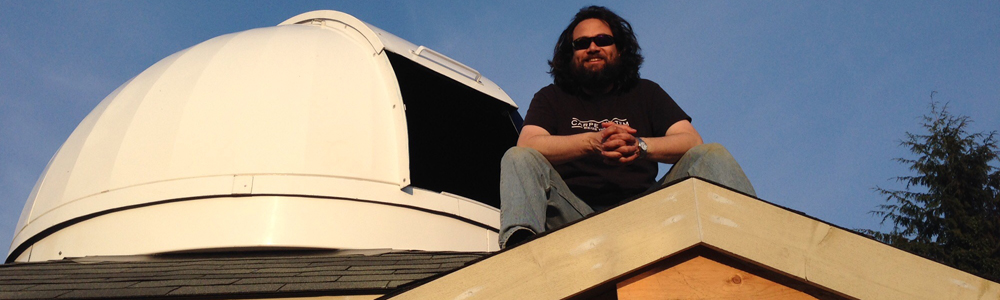
With that in mind, I’ve been thinking about designs for the new Ad Astra Observatory at Hilltop.
I’d like to be able to mount up two scopes at once. Having only one mount point meant that if the scope was doing photography, I could either sit in the cold with hand-held binoculars, or I could go inside and watch TV. Needless to say, I am not the greatest visual observer, through lack of practice, if nothing else. There’s a strong possibility that the second mount would (eventually) be a GEM also, either doing visual work, or doing widefields or planetary while the main mount cranks out DSO’s. Anyhow, 2 scopes means more footprint.
I’m torn between another roll-off (or two) vs. a dome (or two domes). I enjoyed the roll-off roof, and it has the secret-squirrel aesthetic appeal of looking like a harmless garden shed. On the other hand, domes offer better dew and weather protection, and a smaller footprint (the roll off roof requires twice as much square footage as the actual usable area, so the roof can roll off to somewhere). At this point, I’m strongly leaning toward a single roll-off roof, but I am really looking at this form all angles. My wife has even given a tentative OK to a two-story structure; might give the house a little more privacy. Hmm.
Building regulations in my area allow a 200 square foot shed to be built without a permit, so I’m currently thinking about a 12′ x 16′ single story or a 10′ x 10′ “tower” or maybe even a 9′x9′ dome over a 9′x13′ warm room… All kinds of options. I’m not sure how to mount a second scope on the second story (as any two-story structure will almost certainly be a dome). Perhaps some kind of “porch” downstairs. The main thing is I don’t want to have to break down scopes every night, so whatever gets done will have to be securable in situ. There may be something very cool that could be done with a SkyShed POD integrated into the lower story…
I’ll need to pull a permit for the 110VAC that I want to put out there, although I’m thinking that I’ll only need a single 20A circuit. Dunno, maybe two — electric space heaters are pretty power hungry and I’d hate to brown out the scope to stave off frostbite.
As near as I can tell, I need to leave 30′ between the shed and the street on the north side, but I only need about 5′ of space between the shed and the fence to the east. I’ve mocked up a bird’s eye view in Sketchup, and will continue to work through the design there.
I need to figure out where exactly the pier is going to sit, and also how high I’m going to mount it. I may end up cutting down my existing steel pier, or recreating a new steel pier, or maybe even mounting up more or less to bare concrete.
I finally got myself together enough (with a little help from my friends) to set up some astronomy equipment.
It took a bit of hunting around, but I scrounged enough parts to put together 04026, Veronica, and the rest of the imaging rig, and set up for a night of starlight.
I was on a tripod in the driveway, not the cushy accomodations I’m used to, but still not too bad. Power and ethernet are available, and there’s plenty of sky.
A few of the neighbors have outside lights they leave burning all night; once I get up and running for good, I’ll speak with them about it.
Polar alignment was first up; I had to bring the mount up 10° for the new latitude. I ran into a bit of a problem here — the mount is built in such a way that it’s difficult to raise the elevation past 45° or so. I ended up having to put a 3 inch “lift” under the north tripod leg to get it to align. Once I got Polaris in the polar scope, though, alignment took just minutes.
Up went Veronica and the cable rig, cameras, etc. Things weren’t in perfect balance, but I went with it.
Ethernet went in without a hitch. Power, ditto. I only had 120v (I hadn’t bothered to drag out the 12v supplies), so I had no focuser, no mirror fan, … well, no, that’s it. Now that the mount has a dedicated 24v power supply, everything else pretty much runs off of 120v.
The guider kept wanting to pick guidestars that were near the edges of the field. shrug. They worked OK. Guiding was hovering around 2″ in Dec all night, about normal for an imperfect polar alignment, imprefect balance, and a bit of a sketchy night, seeing wise.
I pointed at M31, way too large for Veronica’s FOV, but with the benefit of being visible in the finder (and nearly visible naked-eye).
I shot a normal sequence of 10min and 5min subframes (we’ll see how that turns out later), and had a grand time watching TV while remotely connected to the mount with VNC.
I started getting tired around 2:30, went outside to shut down, and noticed that it was starting to cloud up anyway. I dragged everything inside for the night, and went to sleep. I woke up to a rainshower. Lovely.
Setting up in the driveway is not as cool as having a dedicated shed. But it felt really good to get out and grab some photons.
The skies are darker here than they were in Newark, by at least a full magnitude.
Ad Astra Observatory has got a new callsign. We are now Ad Astra Observatory at Hilltop (WA).
sic itur ad astra
An aside on “hope” for a second… bear with me.
I read Greek Myths a lot as a kid, and so of course I read the story of Pandora dozens of times. All of the awful things in the world were inside the box, and she released them all, but closed the box just in time, and Hope was the only thing left in the box.
I never really thought about it, but it’s kind of deep if you think about it — Hope was in there as an “evil”. As in, it’s that thing that makes you feel like things could ever be different, when it’s really all a whole lot of “all things being equal, the future will be much like the past”. Hmm.
Like, for instance, I hope that I’ll be able to do some astronomy from the Pacific Northwest, despite the clouds in mid-May.
Back to the show.
We’re still early in the process, but I think I’ve found the site for the new Ad Astra Observatory. There is an area that is flat, level, and has open skies, and it’s for sale! Yes, there’s a house on the land, and there’s a certain amount of paperwork that needs to be completed. Details.
The point is, I found a place for the telescope.
…
I hope.
Well, the contents of the observatory are now packed away someplace even smaller than they are used to, a 5′x5′ storage unit in WA.
I didn’t hear any tinkling glass while moving the stuff around, so hopefully all is well.
Veronica, Trixie, Cassie, this is my promise that I’m coming back for you. Stay safe.
After a nearly five-year run, I closed the roof of the observatory for the last time last night.
Spring has sprung in the Bay Area, and it’s been clear for the past few nights. One expects this to continue for several months, if past years are any indication.
But, I’m moving my family north, and that means that the shed is getting emptied.
I’ve really enjoyed the time I’ve spent, learning the sky from my backyard. I hope that I’ll have another avenue to the stars available sometime in the near future. I know I’ve done more astronomy in the past few years because it’s been so easy to just hop outside on a clear night.
Over the next couple of days, I’ll be tearing down the mount and pulling out the pier. Once that’s done, I’ll immobilize the roof and patch the hole in the floor, and the Sky Shed will revert to a Garden Shed.
Good night, Ad Astra Observatory at Newark, CA. We spent some good hours together.
The NJP’s state when it got back from “repair” was pretty sad. I mean, even a poorly working NJP is better than I’d ever really gotten with the G-11, but it needed some TLC, badly.
Before I could get to work on the mount, though, I had to put the observatory back in order. I had never really cleaned up after the trip to GSSP last year, and stuff was really starting to be piled up, making it tough to move around, let alone do intricate mechanical work.
So I spent some time getting stuff put away and horizontal surfaces cleared and things moved to the walls where possible. It’s not totally spic and span, but it’s looking a lot more like normal now.
So. The mount. I dismounted Veronica, pulled off the saddle and adapter, and started looking at the Dec axis first. I couldn’t really tell what was going on right away, so I kind of just started ripping things apart until I figured it out. I found out that the gear attached to the motor actually has a little play in it, which means that I was not going to be able to get all the play out of the Dec axis. But it was pretty minor, so I decided that I’d just move forward.
I put some thin paper in between the gears (I used party streamer, because I couldn’t find my Zig Zags). I pulled out my feeler gauges, and made sure that both pins were seated the same amount, with the gears meshed. It took a couple of tries, but the gear mesh is now nice and tight, both bracket pins have the exact same spacing, and, wonder of wonders, when I put the gear cover bracket on, I was able to adjust it so that it no longer scrapes! While I had it apart, I noticed that someone had taken a file to the edge of the cover. Not really a normal method of repairing this part; I could have done that myself if I’d known that was the method to be used. I think I could get a little more clearance, by holding the bracket in a different position relative to the mounting posts as it got tightened up. It’s clearing now, so I’m not going to worry about it.
The adjusted Dec axis feels really nice; I powered up the mount and confirmed that it would run in both directions.
With the Dec axis completed, I stopped to think a bit about the RA axis. The RA axis came back to me with a lot of slop. I really wanted to take out the backlash, but there are a lot more moving parts involved in getting the RA axis diagnosed. As I’d already had the axis mostly apart before, as I tried to figure out if I could adjust the reticle myself. I had decided that the reticle was too complicated to mess with, but this time, I thought I might be able to find out what was wrong with the backlash.
It turned out to be a pretty simple repair.
First, I unscrewed the rear cover, which revealed the main axis cover. The main axis cover is mottled black, and has 4 set screws that hold the machined brass RA axis in place. With the setscrews loosened, the main axis cover unscrews, to reveal a conical bearing, conical bearing seat, and a few large washers. From my many times messing with the G-11, I realized that, at this point, I could probably just pull the RA axis out.
This suspicion turned out to be well-founded.
I found a soft place for the Dec axis (with RA shaft still attached) to land (this needs to be thought-out, because the cable harness is still attached), and out it came.
Doing this revealed the main RA gear, the upper conical bearing, and a thrust bearing setup (washer-bearing-washer). Under the main RA gear, there is a “ring” of metal that gets squeezed by the axis lock. That ring’s housing attaches to the Dec axis housing via a very large machine bolt.
With the gear train of the RA axis all apart, I started hunting for sources of backlash. There were essentially 4 places that could have been problematic:
1) play in the main gear attached to the motor shaft
2) gap between the motor shaft gear and the worm shaft gear (the “normal” place to adjust the axis)
3) improper centering of the worm gear housing (more on this in a bit)
4) play in the RA housing somewhere (not something I’d originally considered)
There was a tiny amount of play in the main gear. A little less than the play in Dec. Again, I decided there was nothing I could really do about it.
The gap between the gears seemed about right; I later ran a paper between them, and it seemed fine. There was still a little play present, but with the gears gapped properly, This didn’t really seem like something that I was going to mess with.
The worm gear housing is definitely not centered in the main gear housing gap. I don’t know what that’s about, but I decided not to change it; I was looking for something “simple”.
And I found it.
The large bolt that holds that RA shaft lock housing to the Dec axis was very loose. The two housings could shift past each other by several millimeters, probably as much as 1/2″. This is just shoddy work putting the mount back together. Nothing else could really explain it. I used my finely-calibrated index finger to confirm that I had the two housings lined up properly, popped a big Allen wrench into the bolt, and was able to tighten it about half a turn before things felt secure. I re-checked to make sure I was all lined up, gave the bolt another tweak, and started reconstructing the axis to see if I’d made a difference.
Putting the axis back together was pretty straightforward; get all the junk on in the right order, make sure everything is lubed properly or it won’t fit (more on tolerances in a bit), put all the parts together, and once I screwed the mottled black RA main axis cover, everything tightened up and into place. I did a quick test to see how the axis felt, and was impressed. I re-tightened the set screws, reinstalled the rear cover, and spent a little time getting all the greasy fingerprints (some mine, some left by the professional “repairs” I’d just had done) off of the mount. With everything tight and back in place, I checked the backlash in RA. It was down to well under 1mm. There is still the tiniest amount of play in the axis, but it’s certainly down in the “acceptable” range. I might try to tighten it up a little more, if I find it to be problematic, but I was ready to declare the mount repair a success!
While I had everything off of the mount, I thought that I should rotate the pier top a little; the way it’s set up, I have to run the mount’s Azimuth all the way to one stop. I pulled the mount, figured out which direction to rotate the top, rotated it, then re-leveled the pier. I actually kind of like leveling, when I have a good tool and a good surface to work with. I had both, and the leveling only took a couple of minutes. I put the mount back up, and moved on to the next task.
I thought about whether to remount Veronica, and I decided that I should polar align with the mount unloaded first. So I left Veronica sitting there, waiting for the sun to set.
I had one last thing to do before sunset, though; the polar scope illuminator has always been a little flaky, and I decided that I needed to fix it. I messed around with it quite a bit, and finally found an LED that would work as a replacement. I de-soldered the original LED, put in a new one, and was pleased to find that the new LED looks very bright. I’m glad that I didn’t ask for this to be “repaired” professionally. For the price of an LED and a couple minutes with a soldering iron, I probably saved myself a few hundred bucks. The new illuminator is visible even during the day, so I was able to get it reinstalled on the mount and all ready to go for sundown.
After sunset, the sky was clear enough to polar align, so I did; using the new reticle with the fixed illuminator made the process simple. I reset the mount’s bubble level to be properly arranged for the new reticle; it’s nearly in CW-down position, but not quite.
I added some Velcro to the saddle and to the USB hub and DSUSB, so now I can just put the cable harness right where it needs to be.
I played around a little with saddle placement. I think that eventually I will want to figure out how to offset the saddle, but for now it’s centered.
I got Veronica back up and cable harness attached. Spent some time getting the balance right. Once Veronica was all mounted up, I pointed over to the moon and focused the camera.
Suddenly, I was ready to start imaging!
Well, ready to test out the imaging rig with the newly-repaired mount, anyway.
I pointed over at Alkaid in The Big Dipper, sync’d the mount, and then did a GOTO to M51 nearby. 3min unguided left some star trails, so I fired up the guider and re-shot a 3min exposure. The guiding accuracy was down in the 0.07pixels (about 0.4″) range in both axes. The stars came out very round, as you’d expect.
I realized that I didn’t have the LPS filter in place, so I reinstalled it, pointed back at the moon, and refocused. Turns out the LPS filter gives a little extra backfocus. Nice! Back to Alkaid (you gotta love the simple pointing model), over to M63 this time, and another 3min shot. Very nice looking galaxy. Exactly what you expect from a 3min shot.
I need to tweak the polar alignment with WCS. I need to get autofocus and plate solving working again. I need to clean the camera optics. There is always stuff to do.
But I hereby declare Ad Astra Observatory at Newark, CA up and running once more.
Finally.
Ad Astra Observatory at Newark, CA is back in business.
The UPS guy dropped the very heavy box containing the mount around 3pm.
I’m not entirely happy with the state of the mount post-repair, but that’s another post.
I put 04026 back on the pier, and started preparing for sundown.
I tried to mount Trixie, but that’s going to take some tweaking. Again, another post.
The LED in the polar scope illuminator is very dim. I tried new batteries, cleaning the contacts, and various tweaks. I finally removed the Tak illuminator, and tried out the LED from the guiding eyepiece. That took a little rigging, but worked… eh, ok. I ended up using a red flashlight , holding it over the end of the polar axis, tweaking the mount, repeat. It took some time. After about 90 minutes, I had Polaris where I wanted it. With a decent illuminator, it would have taken minutes, if not seconds. I did a quick test of the reticle alignment, by rotating the RA axis through 270° or so. It was difficult to get a perfect reading, but it looks like this reticle is installed properly, leading me to believe that I’m not crazy and that the old reticle was out of alignment. Nifty!
To really test the polar alignment, I needed to mount up a telescope.
I chose Veronica (had to remove one of the Dob bearings
), and got the mount balanced, eyepiece and finder installed, and finder aligned. All of this went pretty quickly.
I pointed the mount at M42, starting to cloud up, but I could still see the nebula. I let the object drift across the eyepiece a little (I hadn’t hooked up power yet); things looked ok.
So I dug out the hand controller and a power cable. The plug sockets are much tighter now; cool.
I recentered the nebula, and came inside to let it all run for awhile. I went back out 20 minutes later, to find the nebula still centered, and the same starfield in the eyepiece.
I decided to take a look at Saturn. Man, I am so glad to have the rings opening up again! Just gorgeous. I left it at high magnification (200x) to further check the polar alignment, but I’m pretty well sold that it’s close enough for visual use.
Welcome back, 04026. It’s nice to have an observatory again.
And thank you, astronomy gods, for a clear night to test my mount.
…with zero dropped subframes.
I spent a little time refining the polar alignment last night. I am still getting some drift while running unguided; I calculated it to be about 6′ from the pole now.
The guiding is even smoother now, if one could believe it possible.
I shot 20m subframes all night. I ended up with 5 frames of M51 (OK, but not worth posting). By the time M51 was finished (around 2am), Cygnus was up, and so I went and grabbed 10(!) more frames of Sh2-101.
The 3h 20m image came out pretty nice, but as always it could use some more integration time:
This is one of my standard 1500×1000 -> 900×600 crop-and-size jobs. There was a lot more context in the image, but Veronica is badly out of collimation at the moment, so there were some badly mangled stars; this is as good as I could get.
Things I noted last night:
- the pier topper needs to be rotated about 1/2″ clockwise, because the azimuth adjustment has run out of room to the west.
- Veronica needs to be recollimated. I am going to pull the long bolts and put the stock ones back in. I think I’m done with the RCC/OAG.
- I am not certain if it did anything bad, but I pulled the webcam out of the OAG and put it into the main focuser partway through the night. I would think that it doesn’t matter where in the FOV the star lies, but better safe than sorry.
- I will not be putting the mount on the tripod for tonight’s star party. I think it’s more impressive on the pier.
- One of the GOTOs last night was so accurate that I looked in the finder, couldn’t find the star, started pushing it around with the hand controller, and realized it was sitting behind the crosshairs. (:
- The mount put up more gaudy numbers; 0.4″ RMS for the night. wow.
A good night. And I got an hour more sleep and still hit a Cygnus target!