
Jan 312012

OK, so I measured the yard, and it doesn’t look like I’m going to be able to get the “peekaboo” view between the house and the shop, at least not for a permanent setup. It’s just too close to the street.

By the same token, I don’t really want a north-roll-off roof, because of the same problem. However, since I’m going to be stuck in a place where the house is blocking Seattle’s light pollution anyway, I might be able to swing a west-roll-off roof, and have most of the south wall roll away, too. It’s a thought.

My ruminations have come down to essentially 3 options:

- west-roll-off roof, 12×16, single story
- 10′ HomeDome in a two-story high tower (warm room below, dome above)
- 12.5′ SkyShed POD MAX dome (or dome + observatory), single story

Kristi has some concerns about the weatherproofing ability of a roll off, and frankly I agree; I would need to spend some time thinking about how to design a roll off system that’s easy to handle but also rain and snow proof.

The two-story dome has some merit; going “vertical” could help in several ways; less ground effect on seeing, more sky because I can see more over the top of the house, maybe even better protection from local light pollution. There may be some problems with permits. This is also the most complicated build of the three.

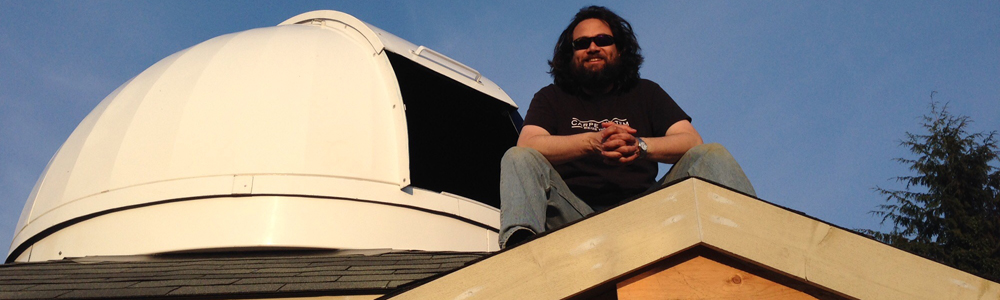
At the moment, I’m leaning toward the SkyShed POD MAX. It’s due for release this summer, it’s more than spacious enough for even my most pie-in-the-sky dream scopes, and if I buy the “observatory” option, it comes with walls, so all I need to build is a deck to put it on.

The benefit of a roll-off is that I can run two scopes at once, and it’s a fairly straightforward build, with lots of framing stuff that your average joe contractor has seen before (2×4 framing, 16″ on-center studs, etc). The drawback is weatherproofing, as I’ve mentioned, and the extra footprint required for the roll off structure.

The benefit of a dome is that I can buy one pre-made, so there’s very little startup work to get going. It’s going to be a big enough project as it is without having to add a complete engineering design to the process. Domes also offer a lot of benefit; better wind, light, and dew protection, and a lot of “cool factor”. The biggest drawback of a dome is that you can only put a single telescope inside. I survived for a lot of years with only one scope in CA, but I really want to be able to have the flexibility to do visual or planetary work while the main scope is crunching away on DSO’s.

My wife has authorized two domes. Actually, she worded it as “no more than two domes” :)
So, the plan might be to build or buy an ~8′ dome sometime in the future, and use that as a secondary mount point, perhaps as a storage area, and perhaps as a warm room.

I have a feeling that once the main scope goes in, I’m not going to be in a rush to put in a second observatory.

I took some measurements with Trixie, and it looks like she requires exactly 8′ of swing in all directions. With a CW bar that extends below the baseplate of the mount, and a telescope that does the same (when pointed at zenith), I’m going to have to do some calculations with regard to pier height. The constraining factors are that I’d like to be able to view down nearly to the horizon (meaning the pier must be tall enough to allow the scope to clear the observatory wall), but the scope can’t scrape the ceiling of the dome when pointed at zenith when it is off-center by 2′ or so (meaning the pier must be short enough not to shove the scope through the ceiling). The floor must be far enough below the scope not to interfere with the scope or CW shaft (meaning a tall pier to help it clear the floor), but I need to be able to get up to the eyepiece on a Newtonian, which gets way up in the air quickly (meaning a short pier or some kind of scaffolding to allow me to get up there and work comfortably with heavy and delicate instruments). This is going to take some 3D modeling.

I still feel like I’m early in the design phase. At the same time, I think I’m on the right track to a solution. There are just dozens of little details that still need to be worked out.

Jan 142012

Seattle weather is not really what I remembered.

From past memory, I recall Seattle weather being solid rain and clouds from October 15 (how many times have I picked a skimpy Halloween outfit only to freeze my tail off when it suddenly starts raining a week before the party?) through May or so, tapering off to a short, but nice, summer of clear weather.

I wasn’t really paying all that close attention to the weather, clearly, because how it really seems to work is:
Oct 15 – Thanksgiving : rain
Thanksgiving – Dec 15 : too cold to rain; clear and very (in the 20′s sometimes!) cold
Dec 15 – Jan 10 : rain (around the Solstice … hmm)
Jan 10 – ? : cold again (first snow this winter came today)
March – May : rain

What this means to an astronomer is that, instead of one long streak of clear sky from spring through fall like CA, the Pacific Northwest seems to get 3 distinct clear sky seasons; one in summer, one in late fall/early winter, one in late winter.

This suddenly turns 6 weeks of decent sky into nearly 4 months, and that makes an observatory sound reasonable. Especially because 2 of the “seasons” are coupled with sub-freezing temps.

Some things went very well with the observatory at Newark, CA. Other things could use some updating. This time, I also have more gear to deal with, and a bit more lofty aspiration for the structure.

With that in mind, I’ve been thinking about designs for the new Ad Astra Observatory at Hilltop.

I’d like to be able to mount up two scopes at once. Having only one mount point meant that if the scope was doing photography, I could either sit in the cold with hand-held binoculars, or I could go inside and watch TV. Needless to say, I am not the greatest visual observer, through lack of practice, if nothing else. There’s a strong possibility that the second mount would (eventually) be a GEM also, either doing visual work, or doing widefields or planetary while the main mount cranks out DSO’s. Anyhow, 2 scopes means more footprint.

I’m torn between another roll-off (or two) vs. a dome (or two domes). I enjoyed the roll-off roof, and it has the secret-squirrel aesthetic appeal of looking like a harmless garden shed. On the other hand, domes offer better dew and weather protection, and a smaller footprint (the roll off roof requires twice as much square footage as the actual usable area, so the roof can roll off to somewhere). At this point, I’m strongly leaning toward a single roll-off roof, but I am really looking at this form all angles. My wife has even given a tentative OK to a two-story structure; might give the house a little more privacy. Hmm.

Building regulations in my area allow a 200 square foot shed to be built without a permit, so I’m currently thinking about a 12′ x 16′ single story or a 10′ x 10′ “tower” or maybe even a 9′x9′ dome over a 9′x13′ warm room… All kinds of options. I’m not sure how to mount a second scope on the second story (as any two-story structure will almost certainly be a dome). Perhaps some kind of “porch” downstairs. The main thing is I don’t want to have to break down scopes every night, so whatever gets done will have to be securable in situ. There may be something very cool that could be done with a SkyShed POD integrated into the lower story…

I’ll need to pull a permit for the 110VAC that I want to put out there, although I’m thinking that I’ll only need a single 20A circuit. Dunno, maybe two — electric space heaters are pretty power hungry and I’d hate to brown out the scope to stave off frostbite.

As near as I can tell, I need to leave 30′ between the shed and the street on the north side, but I only need about 5′ of space between the shed and the fence to the east. I’ve mocked up a bird’s eye view in Sketchup, and will continue to work through the design there.

I need to figure out where exactly the pier is going to sit, and also how high I’m going to mount it. I may end up cutting down my existing steel pier, or recreating a new steel pier, or maybe even mounting up more or less to bare concrete.