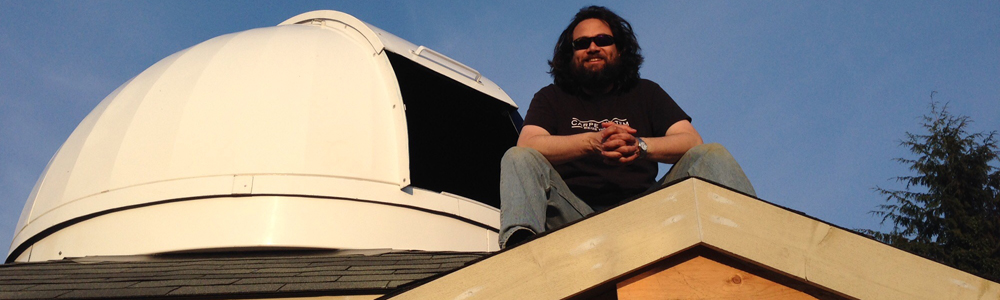

I’m in WA for 2 weeks in what should be a fairly dark sky area. It’s been a bit cloudy, so last night was the first night I was able to even get things set up and polar aligned, etc.
I’m still a bit rusty getting things together while I’m on the road, but after my test run at Clear Lake, CA a couple of weeks ago, things went much more smoothly this time.
In particular, the battery behaved to spec. Not a problem slewing the scope around and driving the ST-4 at the same time.
I got barely enough time between the clouds to get set up, get a decent polar alignment, and shoot a very small pointing model.
I also tried out the new RCC, a coma corrector for Veronica that’s much like the MPCC I already have, but is designed with an extra 36mm of backfocus, which means that I should be able to drop the off-axis guider in between camera and corrector. Nice!
So, I tried it out, and, like every new piece of equipment, it will take a little elbow grease to get it working right.
The RCC has a larger backfocus requirement than the MPCC did, so I am going to have to re-collimate Veronica to accomodate, pushing the focal plane up the tube a little further. Once I get everything to come to focus, I will need to ensure that the main camera and the autoguider are both in focus, as well. That will have to get done on the next clear night (or I can try to play some games with focusing during the day at something that is really far away).
Also, I need to take the wobble out of the OAG, and adjust the T-ring so that the OAG has room to maneuver (you need to be able to rotate the OAG in order to find a star bright enough to guide on).
If all goes well, this will obviate the need for a guidescope, a prospect that I relish.
rain, rain, go away. please come back once I go home.
How things change, seemingly overnight.
When the Nikon D70 died at the end of May, I was devastated to lose my primary imaging camera. Luckily, I had a backup ready to jump in to fill the void.
And, like it always seems to go in the NFL, the backup turns out to be a nice performer, and the old workhorse is coming back to sit on the bench.
After fighting against the perception that the Nikon is an inferior astrocamera for 4 years, I dropped the Canon into place and found that all of a sudden my life got easier.
The shutter-control hardware is so easy to use that I created a Canon shutter control circuit on a Saturday morning (including code). It’s both less fiddly and easier to implement than the Nikon’s shutter control.
Although I am enjoying the T-threaded Ha filter (which would work for either Canon or Nikon), and it’s been a great introduction to narrowband imaging, there’s a clip-in version (for Canon only, of course) that’s going to be the final solution, because it doesn’t add length to the imaging train (and thus doesn’t throw off the corrector/flattener spacing).
And, most damning, the images that come out of the Canon are noticeably less noisy than the ones that came out of the Nikon. There is something to this “Canon RAW = RAW, Nikon RAW = Medium Rare” argument.
The Canon is not a panacaea — like the Nikon, there is still amp glow to be removed with darkframes (the Canon users don’t often mention this). I find the on-camera controls slightly more awkward on the Canon than the Nikon (I still haven’t figured out how to zoom on the LCD, for instance). Because I don’t have a Stiletto module for the Canon, I have to focus the camera by the tried-and-true “shoot a photo, move the focuser, shoot a photo, repeat” method, which is slow. And it’s still a DSLR, so it’s one-shot-color (a benefit or drawback depending on the day and target), it’s uncooled (see “dark frames” above), it has a deeply-set CCD that eats up space in the imaging train, and of course, MaxIM DL loves to crash while trying to connect/reconnect.
But at the end of the day, the quality of my images has increased, and the ease with which I capture them has increased, and the Canon is now the camera that sits on the focuser, and the Nikon sits in the camera bag, waiting to be called up for star trails, widefield, or other “backup” work.
The seeing was pretty bad last night, as in “wind blowing so hard that I thought the leaves rattling were raindrops and ran outside to check”.
This wreaked havoc on Veronica’s guiding. So, the stars were not perfect in any of the shots, but they were all about evenly bad, and there were SIX HOURS of them.
So I decided to stack them up anyway.
This is Sh2-155, The Cave Nebula in Cepheus. This object is way down over the house early in the evening, but I imaged for so long that the telescope hit the pier again this morning. I intended to shoot Sh2-155 for just an hour or two, then swap to IC 1848 The Soul Nebula, but the seeing was awful and I decided to stick with the object, hoping that it would get better as the night dragged on.
Sh2-155, The Cave Nebula in Cepheus

18 frames. 20 minutes each. Six hours. Wow. Oh sure, the image could be a little tighter. But you gotta love li’l P and how the photons just come flowing in.
The problems with Veronica are still bothering me, but I’m trying to put that out of my mind for now, and just enjoy imaging for awhile.
After 10 days of fighting Veronica, I’d had enough. Tonight, I swapped the camera back to Pumpkin, rebalanced, and tried my luck at two targets.
With Cassiopeia showing above the house, I decided that I wanted to try for IC 1805 and IC 1848, The “Heart” and “Soul” Nebulae that lie between Cassiopeia and Perseus. Note that it’s July, not October. But, since Pumpkin seems to do pretty well (owing in no small part to the 5”/px and huge FOV and huge guidescope), and since I like to avoid running the scope into the pier, I find that I choose objects that are “a little low” and let them rise all night.
But these guys were still below my “horizon” (read: The wall of the observatory
) yet, so I needed to shoot something else for an hour or so, until Cassiopeia rose a little bit.
So, I decided to continue my widefield survey of Cygnus/Cepheus, and did an hour (back to 20m subframes — I love that li’l orange scope!) on Sh2-119.
The Sharpless nebulae are opening whole new vistas in my target list, and I’m *really* enjoying going after these objects in full knowledge that I’d probably get nothing but noise and pain if I tried this without the Ha filter.
I like Cygnus. It’s really good to have Pumpkin back. I have nothing more to say about this object.
Now it was late enough that I could start getting some time on Cassiopeia. Some clouds threatened to roll in, ate my guidestar for awhile, etc. Pumpkin just powered through all that. I only lost one frame out of 13 (to clouds). Since IC 1805 was laid in “horizontally”, I missed the nearby IC 1848. That’s for tomorrow night. This is a full 4 hours of Ha from Pumpkin on an object that I have no right to be shooting for another few months.
IC 1805 The Heart Nebula in Cassiopeia
In a word, Wow. I’m back on track again. I am having fun with my widefield shots in a way that I haven’t been having fun for awhile now. I want to buy an OIII filter and go back and shoot all this stuff again. I am giddy when I see the cool stuff show up in each subframe.
The guiding is a little rough. But the results speak for themselves. I am ready to shoot my way through the rest of the month. Yay!
In a last-ditch effort to make Veronica work with the mount, and since it’s Friday night, I decided to really tweak the scope before starting up, then do a series of “test” shots to decide what actually works.
I had balanced Veronica “forward” in the tube rings to help get a little more time past meridian before the scope hits the pier. I moved the rig back to the center of the rings, and rebalanced “to within an inch of its life”.
Then, I re-adjusted the RA worm to remove as much play as I could. It was a bit of a Q&D job, but I’m getting pretty good at it, so I think I’m OK. There is still the tiniest amount of “wiggle” if I grab the scope and really push it around. I’m not sure how to fix that, though. I tightened up as many of the other mount bolts that I could think of, while I was at it.
Then I decided to shoot one hour each of 5m, 10m, and 20m subframes on a nice, easy subject, M27 The Dumbbell Nebula. As I expected, the 5m frames worked, but both the 10m and 20m frames (all of them) were trash.
Here’s M27, The Dumbbell Nebula in Vulpecula
The Dumbbell is a really easy target. It’s big and bright and looks good at almost every exposure length from 30sec right on up. At 5m in Ha, it’s spectacular. There are little prominences of vapor coming off of the main nebula that I’d never noticed before. Nice. This is just 1 hour, but I’m happy with this result.
Once I figured out that 5m is what I should be shooting (and since it was now 2:30 in the morning and the autumn constellations were in the “sweet spot” for guiding), I decided to do a quick little test, an object that I wasn’t expecting to do well in Ha, but since (at this point) I knew that this was Veronica’s last night as the “main” scope for awhile, I wanted to go out with a nice solid test shot for future study.
I chose M33, The Great Triangulum Galaxy. Galaxies are made of stars, which throw (more or less) full-spectrum light, so for the same reason that I don’t have to worry about the local shopping mall that leaves their parking lot lights on all night, galaxies are not really what one would consider a “narrowband” target. However, at the same time, M33 is both large (3rd largest galaxy in our local neighborhood) and close (next closest after Andromeda), so much so that certain nebulae *in M33* have their own, separate NGC numbers (because at the time, it was not understood that they were really part of the same object). So I wondered ifI could pick some of that detail up.
The results speak for themselves.
This is 100m (3h 20m), 20 5m subframes of M33 in Ha through Veronica.
M33, The Great Triangulum Galaxy

There’s a decent amount of detail there. Even in Ha, it’s obvious that this is a spiral galaxy; you can see the arms in the clouds of hydrogen. And of course, I picked up some of M33’s brightest nebulae.
NGC 604 is the knot of bright nebulosity at upper left. NGC 604 is pretty bright, considering it’s millions of light years from here. That’s because the nebula is 1500 light years across. The distance from Earth to M42, The Great Orion Nebula, is 1500 light years. If we were in M33, the NGC 604 nebula would cover that entire distance. Wow. It’s huge, huge, huge.
In all, a successful image of M33. Makes me want to shoot M31 with Pumpkin in Ha.
At this point, though, I’m pretty frustrated with Veronica as an Ha scope. Flashes of brilliance, but a lot of fighting the mount to make things happen. I’ve decided to swap the camera over to Pumpkin to finish out the moonth. Back to some easy widefields for awhile.
Veronica is now a gigantic guidescope again.
OK, this is getting silly. Either I have no idea how to balance a telescope properly (which is not outside of the realm of reason), or balance is not the problem with the rig. On the other hand, I get this very distinct oscillation that’s worse at either end of the run and OK in the center. grr.
So, as usual, I only saved 5 out of 16 images.
However, they came together OK. Here’s The Cocoon Nebula, IC 5146, in Cepheus:
Here is a cropped view of the object (1500×1000->900×600 as usual)
The large image is slightly cropped from the full frame as well, but at lower right, you can still see the “Star Wars” effect that I’m getting because (I believe) the spacing between the MPCC and the CCD is being thrown off by the Ha filter (it goes camera, T-ring, Ha filter, MPCC, focuser, and the MPCC wants to be 55mm from the camera, but the filter is extending that slightly). I’m going to ignore this for now, since it’s a small quibble when I’ve got a bigger problem.
My next trick is to add a Barlow (telextender) to the guidescope, in hopes that guiding at a higher magnification will help the scope get rid of this crazy oscillation. Also, I’m going to make an animated GIF of the images so that I can analyze the oscillation more carefully. Stay tuned.
Cepheus is still a little low in the sky to get a full treatment. But I wanted to see what would happen if I shot an object that was low enough that the scope didn’t collide with the mount during the night.
I learned something very interesting. The mount has tracking problems outside of a certain “good” range. I had been starting my evening in this “good” range, and thus only getting a few good images at the beginning of the evening, with junk after that. Last night, I had some junk at the beginning of the evening, getting progressively better for awhile, then worse at the end of the evening. Very interesting. At least I have something to work with.
In any case, this time, instead of getting 4 or 5 out of 16, I got 8 out of 16 images (because I got the whole “bell curve”.
This is NGC 7635, The Bubble Nebula. The bubble is being created (from my understanding) by a Wolf-Rayet type star, which is apparently cranking out some serious solar wind and making a bubble in the surrounding nebula.
I just think it looks cool.
Here’s a closer view of the nebula core:

In each of these images (and most other images on my website, I followed my normal resizing pattern:
- for a “full frame” image, I crop to the largest 3×2 aspect ratio image I can
- for a “cropped” image, I crop to a 1500×1000 area
- either way, I then resize down to 900×600
900×600 is a nice size for the web, usually produces astroimages that are ~100k in size. Resizing down a little helps to “tighten up” the image, makes things look a little sharper, de-emphasizes the noise in the image, etc.
What I’m saying is that, generally, shots from Veronica can be as large as 1.3°x0.9°, but often I’m taking a 0.6°x0.4° chunk out of that. So far, with Pumpkin, I’ve always done full frame, because that’s sort of the point of a widefield scope. Pumpkin’s field is about 4.2°x2.8°. But because I do some cropping and resizing, the scale from image to image is not an exact 1:1 match to other images. The 1500×1000 -> 900×600 type images are all the exact same scale, of course.
My goal, instead, is to make the object as large as possible in the final image, while maintaining some kind of concept of scale.
I’m having a tracking problem with the mount. This is all eerily familiar. Things run fine for a couple of hours and then the wheels fall off.
This results in only being able to use a fraction of the frames that I shoot in a given session. Very irritating.
I adjusted the counterweights last night, making the mount slightly heavy to the east, rather than being in perfect balance. I am told that this keeps the RA gears meshed, which helps the tracking. Perhaps I didn’t find the sweet spot of east-heaviness. Perhaps the whole concept is hooey. All I know is, I again lost 2/3 of my frames; what follows is a stack of frames 3,4,5, and 7 out of 16.
I adjusted the CW back to near balance when I shut things down.
On a slightly positive note, the mount hit its safety limit and stopped tracking before touching the pier this morning. This is a function of where the object is in the sky, but joy anyway.
Last month’s shot through Pumpkin shows, as usual, much more context around the target.
NGC 6888, The Crescent Nebula in Cygnus

Another nice Ha image, another night where I’m a little disappointed in the mount’s performance. I may have to tweak the balance a little more.
Saturday was cloudy, but Sunday night was clear, so I set up the scopes for another night of photography.
I decided to shoot Sh2-101, The Tulip Nebula. I am still working on figuring out what Veronica’s FOV is compared to Pumpkin’s. This nebula turns out to be nicely-framed in Veronica’s FOV, big enough to show detail without cropping, small enough that it’s not difficult to cram in. As usual, Veronica is the workhorse telescope she’s been for me for 5 years now.
I am having some kind of strange error on the mount — it works fine for about 2 hours, then goes nutty and all the images have trailed stars after that. On Friday night, where it was pretty cloudy, I was willing to blame the clouds for this. But I didn’t see any clouds on Sunday (which is not to say they didn’t appear after I fell asleep). I worry that I’m having a cable-pulling problem or some kind of imbalance thing going on. This will take further investigation, but I’m quite frustrated that essentially I am wasting 2/3 of my shots (and all of the ones after I turn in). Again, this image is 6×20m, a full 2 hours, but I threw away another 9 or 10 images that were on target but with trailed stars. I’ll play with the balance and see if that does anything.
Anyway, such as it is, here is last night’s image:

Compare to my previous shot. It’s a different kind of “feel” between the two images — Veronica highlights the brightest part of the nebula, and produces lots more detail because of the extra magnification. Pumpkin gives much more context to the area, and I certainly never would have known about all that wispy dust lane detail if I’d only seen the Veronica image.
It seems that the two scopes match each other in resolution pretty well. I’m looking forward to more Cygnus hunting with Veronica this month!
Now that the Gemini mount is back in service, I decided to try out higher-magnification photography with the new Ha filter. I had a little maintenance to do first; focusing both cameras and aligning the finders. This goes quicker and quicker each time I try it. During the bright moon, I had also rebalanced the scope further forward (in hopes that I’d get more time imaging before the scope hit the mount), and tightened up the Dec axis (which had come loose during its transit to and from repairs in WA).
With everything ready, I needed to decide on a target. The skies were a little hazy, but the guide scope aligned right away, so I figured I could get some photons in before it really clouded over.
I retried my old nemesis (now turning into a bit of an old favorite), NGC 7000, The North America Nebula. I knew that Veronica would only get a small portion of the nebula compared to Pumpkin, and from my previous shot, I knew just the section I wanted to magnify; the “Central America” region of NGC 7000 is the brightest part, and has lots of wispy detail. I hoped this might fit in Veronica’s FOV. After a little “hunt-n-peck” shooting in the area, I figured out where the portion I wanted was (GOTO doesn’t help much in this case, so I had to resort to using a star chart and my knowledge of the area to find it), I found a nice bright guide star (a little brighter than normal because of the clouds), and started up a long imaging sequence.
When I woke up in the morning, the scope had hit the pier again as usual, but it had time to capture 15 frames, so I was looking forward to seeing what I’d captured. When I checked my images, I’d of course lost the last 3 to tracking errors, but unfortunately, it looks like the clouds ate several more. Only the first 5 images were usable, so this is an hour and 40 minutes. Having said that, I’m far from disappointed with the results:
Wow. Veronica does a great job on Ha, and the framing was exactly what I was hoping for. I’d love to see more integration time, but I’m pretty satisfied with what I’ve got.
When I woke up at 5am to shut everything down, there were two really pretty solar system pairings in the sky. High in the southwest were the moon (waning gibbous) and Jupiter. Fairly high in the east (between Aldebaran and The Pleiades) were Venus and Mars. Very cool!


